

Market
Ba’oya Hubuk’esi (I Love Them By the Edge):
Creators' Favourite Sluts Art Market
13 February 2026
5:00pm-8:00pm
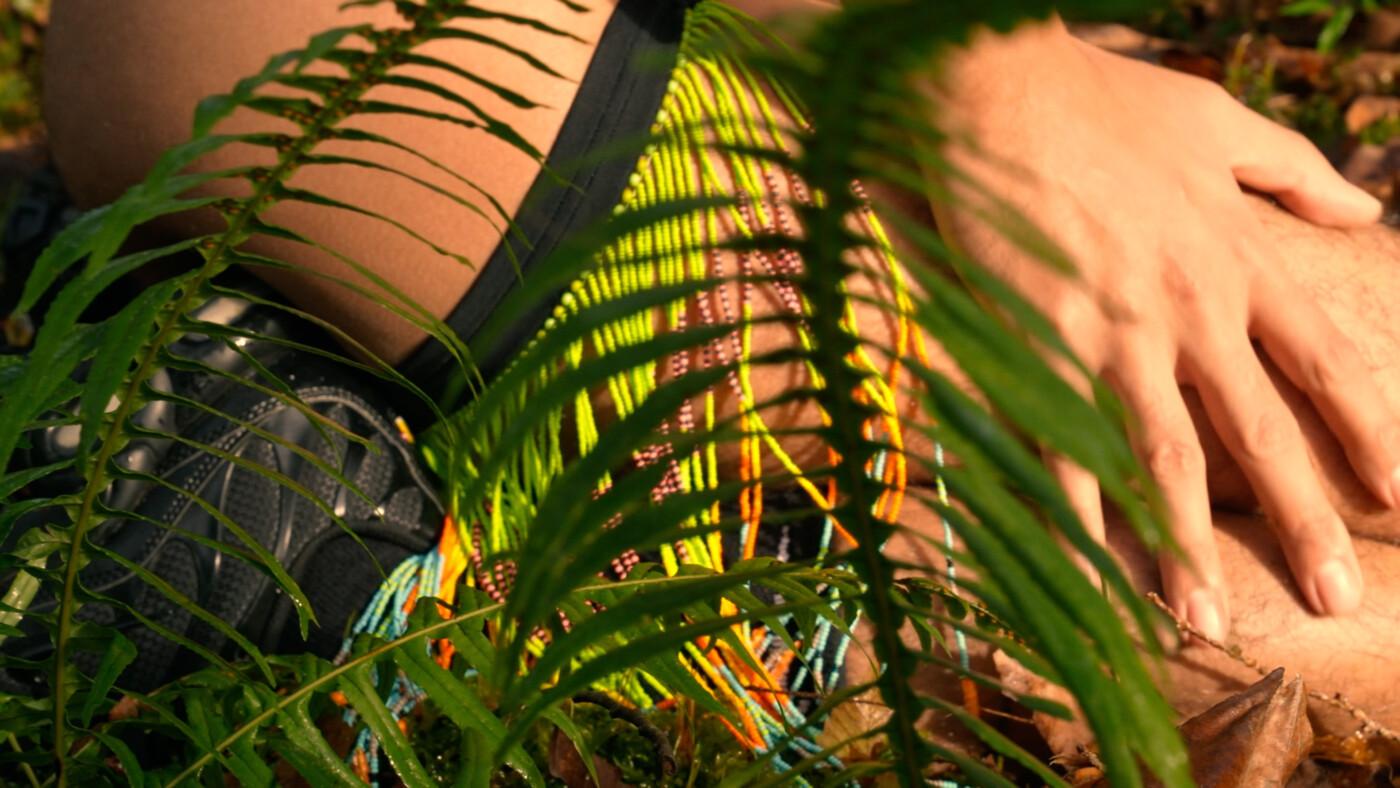
Vance Wright, Fringing; Finding The Edges, Film still, 2026. Courtesy of the Artist.
Please join us on Friday, February 13, 2026, at grunt gallery for the Creators’ Favourite Sluts Art Market featuring jewelry, risograph prints, collages, illustrations, textiles and more from Indigenous artists and vendors:
- Jasper Berehulke
- Whess Harman
- Rawan Hassan
- Leanne Inuarak-Dall
- Jacqueline Morrisseau-Addison
- Cole Pauls
- Eliot White-Hill
- Vance Wright
This program is co-presented by Or Gallery in partnership with grunt gallery and is presented in conjunction with Vance Wright’s exhibition Ba’oya Hubuk’esi (I Love Them By the Edge), on view at Or Gallery from January 22 to May 2, 2026.
With Support From
Participant Bios
Jasper Berehulke
Jasper Berehulke (he/they) is a transgender, two-spirit Syilx Okanagan and Ukrainian artist based on MST lands. Their practice blends manga-inspired contrasts with colors drawn from the land, producing paintings, prints, keychains, stickers, and illustrations that explore identity, cultural reclamation, and queer joy through inviting, evolving, and personal work.
Whess Harman
Whess Harman (he/they) is a member of the Carrier Wit’at Nation, a nation amalgamated by the federal government under the Lake Babine Nation and currently resides on the traditional territories of the Musqueam, Squamish and Tsleil-Waututh peoples. He doesn’t like cops and believes in land sovereignty for Indigenous peoples all across the globe, including Palestine. In his arts practice he works primarily in drawing, text and textiles. As an independent curator and occasional editor and contributor to a variety of small publication projects, he prioritizes emerging queer and BIPOC cultural workers and artists.
Rawan Hassan
Rawan Hassan (she/her) is an interdisciplinary visual artist based on the unceded and unsurrendered land of the xʷməθkʷəy̓əm, Sḵwx̱wú7mesh, and səlilwətaɬ Nations, colonial known as “Vancouver”. Her works explored the complex relationship between preserving and evolving Palestinian craft traditions, such as tatreez (embroidery). She explores materials that embody the questions of what was and what could possibly be through textile-based artworks and drawings. Her hope, is that her practice might open up the conversations on Palestinian identity, grief, resilience, resistance against erasure, ongoing occupation, colonization and potential forms of Palestinian futurism.
Leanne Inuarak-Dall
Leanne Inuarak-Dall (she/her) is an emerging Inuk/settler multidisciplinary artist and curator with matrilineal family ties to Mittimatalik, NU, who is based on the unceded traditional territories of the xʷməθkʷəy̓əm, Sḵwx̱wú7mesh, and səlilwətaɬ Nations. Her visual practice incorporates found and gifted objects with beadwork, photographs and traditional materials to explore stories of exchange, labour and care through the lens of an urban Inuk raised in the South. Leanne graduated with a Bachelor of Fine Arts, majoring in Visual Arts in 2025 from Emily Carr University of Art + Design (ECU). Curatorial projects include TETHER, the feature exhibition at the 2022 Arctic Arts Summit in Whitehorse, YT, and the 30th annual Indigenous student exhibition Beadsoup! (2025) at Emily Carr University of Art + Design. Forthcoming projects include Somewhere We Have Travelled, an exhibition featuring ECU’s Indigenous alumni, co-curated with Vance Wright.
Jacqueline Morrisseau-Addison
Jacqueline Morrisseau-Addison (they/she) is an Indigiqueer Saulteaux and English interdisciplinary cultural worker based in so-called Vancouver, BC, on the unceded territories of the xʷməθkʷəy̓əm, Sḵwx̱wú7mesh and səlilwətaɬ peoples. Born on the traditional lands of the Niisitapi (Blackfoot Confederacy), colonially known as Lethbridge, AB, their family ties are to Keeseekoose First Nation in Treaty 4. Immersed in the Anishinaabe practice of bīskabiyang (returning to ourselves), Morrisseau-Addison weaves together dreaming, beadwork, textiles, performance, photography and film, and site-responsive installations to nurture processes of repair, consent, kinship and care. Through their work, they seek to create spaces of reflection and intergenerational connection through material and spiritual practice. Their work has been presented in group exhibitions across Canada, including Emily Carr University of Art + Design, the Yellowknife Visitors Centre, the Burnaby Art Gallery, the Polygon Gallery, Articule and the Southern Alberta Art Gallery. Morrisseau-Addison holds a BFA from Concordia University and is currently completing their MA in Art History at the University of British Columbia.
Cole Pauls
Cole Pauls (he/him) is a Champagne and Aishihik Citizen and Tahltan comic artist, illustrator, and printmaker hailing from Haines Junction (Yukon Territory). He holds a BFA in Illustration from Emily Carr University of Art + Design. Residing in Vancouver, Pauls has created four graphic novels: Dakwäkãda Warriors (2019), Pizza Punks (2021), Kwändür (2022) and We See Stars Only At Night (2025). In 2017, Pauls won Broken Pencil Magazine’s Best Comic and Best Zine of the Year Award for Dakwäkãda Warriors II. In 2020, Dakwäkãda Warriors won Best Work in an Indigenous Language from the Indigenous Voices Awards and was nominated for the Doug Wright Award categories The Egghead & The Nipper. In 2022, Artspeak Gallery, in Vancouver BC, held the first solo exhibition of Pauls’ work, Dazhän Kwändür Ch’e (This is a Story). In 2023, Kwändür won the Roderick Haig-Brown Regional Prize from the BC & Yukon Book Prize.
Eliot White-Hill
Eliot White-Hill’s (he/they) Coast Salish name is Kwulasultun, and their Nuu Chah Nulth name is Kwaayas. They are descended from the White family of Snuneymuxw, the Hamilton family of Hupacasath, and the Rice family of Penelakut, with roots that branch out far across the Pacific Northwest.
Graduated from Vancouver Island University with a Bachelor of the Arts, Liberal Studies major and Philosophy minor in 2018, White-Hill works as a Project Coordinator with Petroglyph Development Group, the economic development arm of the Snuneymuxw First Nation.
White-Hill is a published author and artist whose written works are fiction in the magical realism genre and whose art is in traditional Coast Salish style. They see all of their work artistically as an extension of their storytelling. They work to tell the stories that have been passed down by their people from generation to generation, to preserve the knowledge that they carry and the profound significance of the way our ancestors saw the world through both written and visual narrative.
Vance Wright
Vance Wright (they/them) is a reconnecting two-spirit member of the Tl’azt’en Nation, and was raised on the unceded territories of the Sinixt Nation in what is colonially known as Nelson BC. Currently residing in the occupied and unceded territories of the xʷməθkʷəy̓əm, Sḵwx̱wú7mesh, and səlilwətaɬ Nations in Vancouver, they are an emerging artist, curator and writer. They hold a Bachelor of Fine Arts from Emily Carr University, with a major in Critical and Cultural Practices and a minor in Curatorial Studies. Their art work has been exhibited in the Contemporary Native Art Biennial (BACA), as well as artist-run centres such as Massy Arts Society or Oxygen Art Centre.